Keats’s Rapid Poetic Development: Some Key Factors & Keats’s Greater Conversation
Fine Judgement
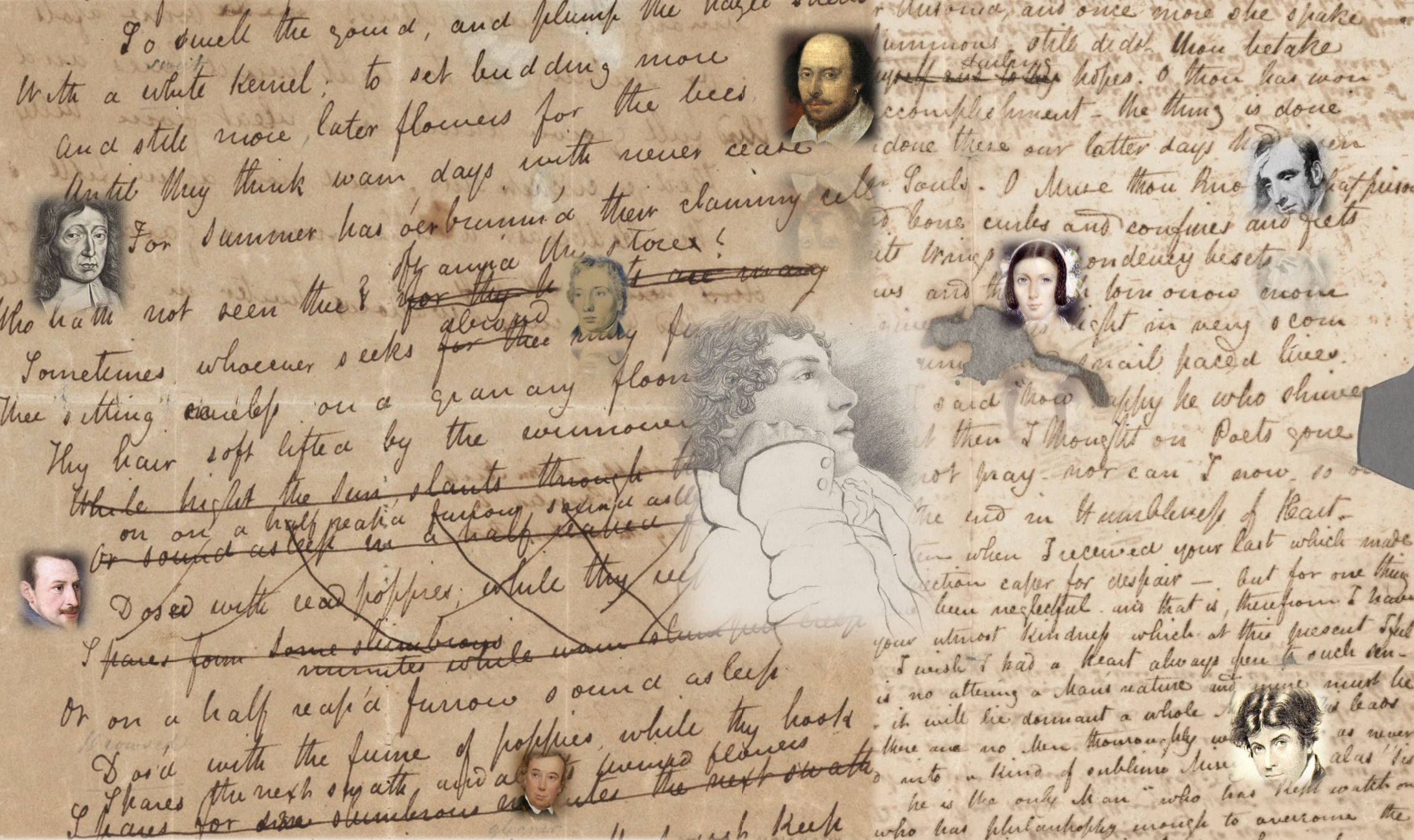
To Autumn,letter to Bailey, Spenser, Milton, Clarke, Tom Keats, Shakespeare, Fanny Brawne, Hunt, Wordsworth . . . ©2021 G. Kim Blank (click to enlarge).
At least twelve key factors or moments (some of them conflated) might be identified in chasing down and articulating what went into Keats’s rapid and remarkable poetic progress—or at least those that emerge from this study of Keats’s development:
~First: Keats’s constant practice in writing poetry since about 1814, and
possibly a little earlier. This reduces to the result of such practice: the poetry
that Keats writes. It involves (not surprisingly) Keats trying to get it right,
which ties to his full clarity of purpose: his clearly-sounded drive to write enduring
poetry.
As a poet in search of voice and subject, his early work diddles with occasion, homage,
and
sociability, but there is little to move him qualitatively forward—and he knows it.
But he
remains driven to keep writing. This factor of constant practice is
necessarily connected to most of the other factors below. Keats’s power begins to
come as he
learns to poetically integrate imaginative acts (as ways of knowing) with the larger
paradoxes
of human experience. What develops, then, is his deliberate escape from poeticisms
of surface
imagination as well as from the confines of short history; this escape takes him into
addressing the deeper purpose of imaginative capabilities and to the complicating
significance
of long history, and this will show itself in the thematics of his greatest poetry—think,
for
example, of how he poetically considers his Greek urn or his nightingale, both of
which are
positioned as a then, a now, and a forever. Then there is the
complex issue of Keats’s developing style: Keats in his best work—that is, in
much of the last year or so of his writing, from about September 1818 (with his start
on Hyperion) until September 1819 (with
the completion of To
Autumn)—develops syntactically natural styles that couple with a new semantic
denseness; the new poetry is generally descriptive and expressive but with learned
purpose, and without much distracting poetic decorum via odd or expected diction,
intrusive rhythm, or over-determined sound for its own sake. Nothing is lost in the
overly
abstract, since, in that best work, were are almost always kept within the experience
of the
senses and the subject as feeling and thought profitably intertwine. Keats, as he
so rapidly
poetically matures, learns to balance—or creatively negotiate—his natural inclination
for
passivity and sensual receptiveness with the non-passive desire for original creation;
this
becomes, as it were, the striving behind this poetic position; as he writes in February
1818,
if Poetry comes not as naturally as the Leaves to a tree it had better not come at
all.
This self-declared axiom marks a kind of sea-change for Keats: it sounds a clearly
determined moment to no longer write for, as it were, artificial reasons, as he acknowledges
through his immature motivations behind composing Endymion. No more of that, he
declares.
~Second, and corresponding with the above: Keats’s increasingly very deliberate study
of poetry—most tellingly, of Shakespeare, Milton, Wordsworth, Chaucer, and Spenser—as well as art
and drama (see his crucial analysis of Edmund Kean’s acting),
beginning in earnest over 1815 into 1816, but set off by the early literary tutelage
of Charles Cowden Clarke, the son of his headmaster at
Clarke’s Academy in Enfield. Keats’s progressive and free-thinking
education at Clarke’s influences his direction, disposition, values, and tastes; and,
very
importantly, for its students, the school purposefully fostered the aptitude for
self-mastering subjects, which becomes evident in the kind of scholarly discipline
Keats
develops in his desire to study in order to become a poet. Behind this is the
obvious picture: Keats as a voracious, critical reader and re-reader; for Keats, reading
is
often the conflated act of discovery and own poetic coming-into-being—that is, for
Keats,
(re)reading is often paired with writing (many early depictions of Keats place him
with
reading material); as a result, it is not unprofitable to read Keats’s poetry as being
about
reading. Keats is also an underestimated student of poetic forms. For example, his
parsing of
the shortcomings of sonnet form takes us to his unique stanza forms in the so-called
great
odes of 1819. Keats’s annotations in what he reads (notes and underlinings) are material
evidence of his vigorous critical bent. Keats sounds his direction often; for example,
on 24
April 1818 (to John Taylor): there is
but one way for me—the road lies through application study and thought.—I will pursue
it
; and on 18 December 1818 (to Richard Woodhouse): I must work—I must read—I must write.
This disciplined, deliberate study of poetry points to and facilitates the third and
fourth
factors.
~Third: beginning 1816 and into 1817, Keats’s letters reflect the development of a
complex and increasingly original poetics that anticipates his progress; he
purposefully formulates what kind of poet he needs to become and what kind of poetry
he needs
to write. Recognizable, and by the end of 1817, and in particular his
letter of 21/27 December, is a direction in his thinking that we might usefully term
Keatsian.
From his poetics and then into his mature poetry, Keats becomes a poet of
controlled, contemplated risk, in both tone (in his lyrical poems) as well as in narrative
(in, for example, The Eve
of St Agnes and Isabella).
~Fourth: as part of Keats’s development of a poetics, is his understanding that knowing what kind of poetry he does not want to write is as important as figuring out what kind of poetry he desires to write. For example, consider Keats’s dawning by crucial recognition that no matter how extraordinary Milton’s accomplishment, and particularly that of Paradise Lost, Milton’s style is not his style; Keats comes to recognize this in his attempts with his Hyperion project(s). Keats nevertheless profits by, for example, critically understanding how Milton’s descriptions powerfully hold a subject, so that they act as both description and action; but Keats concludes that Milton’s poetry actually draws too much attention to its style—and that is not what Keats hopes to exhibit in his poetry. Thus, as in the case of studying Wordsworth (as well as coming to terms with Hunt’s poetry and Robert Burns’s poetical career), Keats comes to distinguish his own poetical character in light of other major poets—his precursor figures. And in the case of Shakespeare, Keats learns that contrasts and oppositions are not exclusive, but deeply bonded by imaginative acts that embrace and then fold into the complexity of the subject. Poetry cannot help but be artifice at some level—call it form—but, for Keats, the drive is to write poetry where artifice is fully subsumed by subject.
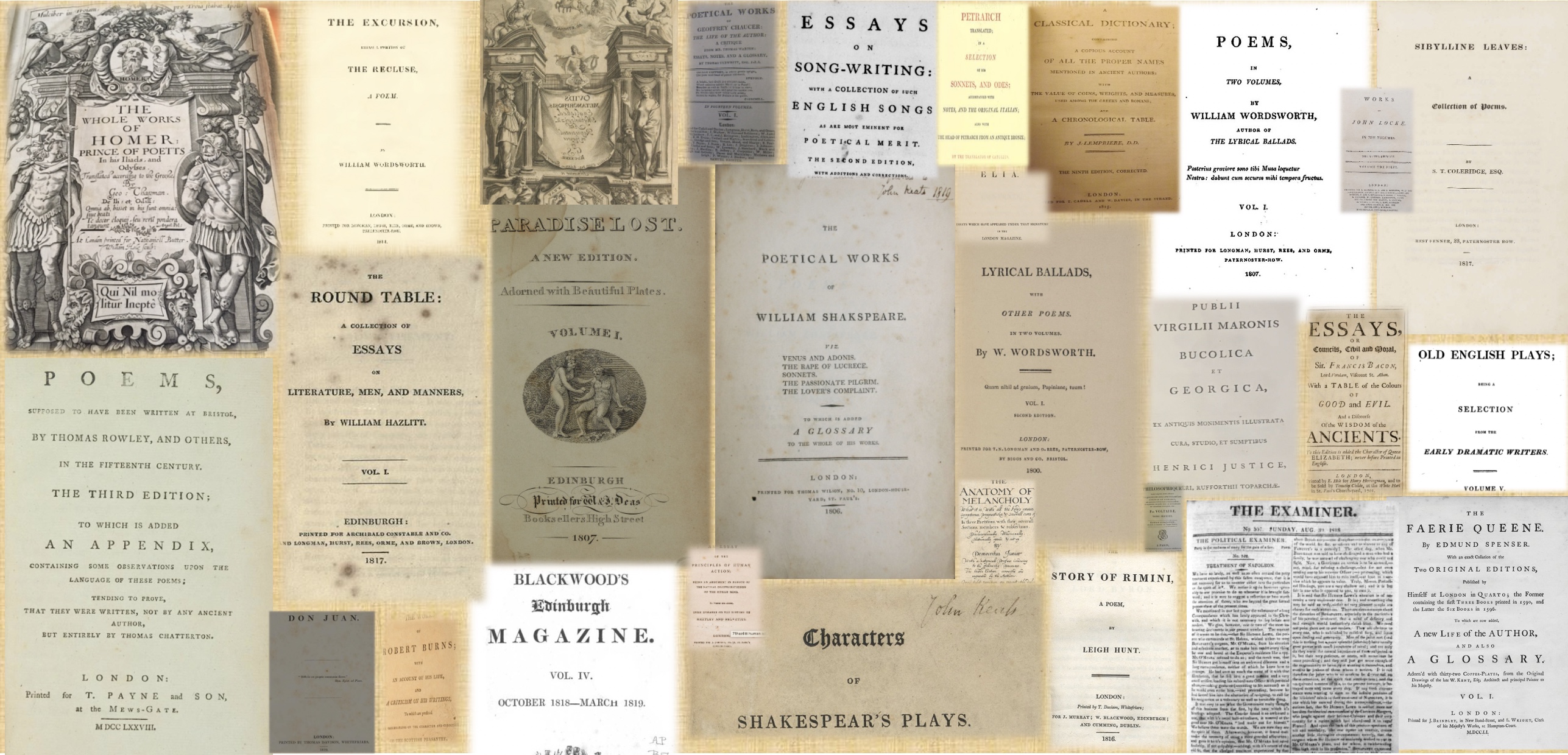
~Fifth: the crucial fact of Keats, starting mainly in late 1816, finding himself within an astonishing intellectual, literary, and supportive network. Much of this is initiated by and channeled through his meeting with critic, poet, publisher, and celebrity journalist Leigh Hunt through Charles Cowden Clarke in October 1816; more than a few within this grouping figure in the development of Keats’s poetics and in encouraging his poetic aspirations. This network includes Benjamin Robert Haydon (painter, public defender of art), John Hamilton Reynolds (poet, writer, reviewer, lawyer), Joseph Severn (painter), Horace Smith (poet, novelist), John Taylor (publisher, scholar), James Augustus Hessey (bookseller, publisher, journal editor), Benjamin Bailey (poet, scholar, translator), James Rice, Jr. (attorney), Charles Wentworth Dilke (scholar, civil servant), Charles Wells (solicitor, minor writer), Charles Brown (minor librettist, business person, but very supportive friend), William Haslam (business person), William Hazlitt (famous literary critic, essayist, lecturer), Richard Woodhouse, Jr. (scholar, literary advisor); and on the periphery, the brilliant young poet and implicit rival Percy Shelley, whom Keats also meets via Hunt. We can (for better and then worse) view Hunt as Keats’s early mentor and promoter, but moving away from Hunt’s sphere of influence (as a literary model, at least) is also key [and this can itself be a separate factor; see the Fifth Factor, below]. We cannot forget that Haydon also introduces Keats to the premier poet of the age, William Wordsworth, and they have contact in late 1817 into very early 1818—Keats is driven to articulate his deep ambivalence toward Wordsworth’s accomplishment and style. Within this above group, Hazlitt might be singled out as spurring and challenging Keats’s tastes and development: his ideas about poetic style and genius, as well as his critical lauding of the Elizabethan poetic temper, and his critical views about Milton, Shakespeare, and Wordsworth, push Keats to establish fairly particular poetic goals. Important, too, is Keats, in corresponding with Bailey, establishing his argument that the imagination is a prime agent of knowing and truth. [For a graphing of this, see Keats’s social network.
~Sixth: the Leigh Hunt factor: Without Hunt and Hunt’s connections, without Hunt’s early encouragements, and without Keats’s anxiety of influence concerning Hunt’s poetry and poetics, would Keats have continued on his poetic path as we know it—would he have developed that highly sought-after original voice? Almost certainly not. That is, at a certain point (emerging in 1817), and with a few close friends who advise him away from Hunt’s influence, Keats critically assesses Hunt’s poetic prowess and style in order to develop his own particular, unique direction. The limits of the poetry of sociability strikes him.
~Seventh: Keats short but valuable visit with Benjamin Bailey at Oxford over September into October 1817: in Keats’s letters while with Bailey, and later to Bailey, we see that Bailey’s theological conceptualizing importantly challenges and begins to force Keats’s thinking about the imagination as a form of knowing, and beauty as a deep form of truth [see 3 September 1817 and 28 November 1817].
~Eighth: preparing Endymion for publication. By copying and reading over the poem as
it moves toward publication, Keats comes to an important moment of realization: it
is for the
most part the work of an immature poet, but he views the poem as a necessary step
in his
poetic growth; he declares, in effect, no more of that, and time to move forward.
That is,
Keats comes both to play down the poem and to place it in the larger course of his
progress,
agreeing that while it is slipshod,
its failure
is necessary as a step toward
being among the greatest
(letters, 9 Oct 1818).
~Ninth: on the immediate threshold of his greatest work, into the most intimate part
of his
world, comes the agonizing death of his younger brother, Tom, in December 1818. The loss of
Tom profoundly deepens Keats’s thinking and feeling about mortality in the face of
death, suffering, sadness, and difficult resolve, and it shapes most of his thinking
about how
beauty, art, and nature will (to quote from his Ode on a Grecian Urn) remain, in
midst of other woe / Than ours, a friend to man.
This quality of depth and
profundity—and the understated style of expression—is simply not present in much of
his
earlier work. In short, the idea of death and duration, which must have been with
him since
the early deaths of his parents, now becomes fully reckoned with in his thoughts and
then
translated into his poetry. We might say that this reckoning is the poetic struggle
of full,
complex consciousness. Tom’s passing brings Keats, quite literally, face-to-face,
with
suffering and death, and then, as subjects, deeply inform almost all of his best work.
~Tenth: not long after Tom passes away, Keats
begins what evolves into a very long journal letter to his remaining younger brother,
George, and his wife, Georgiana, who have moved to America in search of
opportunities. The letter, which dates from 14 February to 3 May 1819, and is taken
up on at
least thirteen days and amounts to almost 16,000 words (counting the transcribed poems),
works
through and up to the very threshold dates when he is writes his greatest poetry.
The letter
provides some of the background and, importantly, the momentum for the astonishing
leap his
poetry makes in spring 1819. The letter begins, mid-February, with Keats waiting for
spring to
rouse
his imaginative capabilities, and then it works its way through subjects,
theories, and concerns that are at the core of what separates his early poetry from
this later
work: life as an allegory, categories of indolence, mutability, disinterestedness
of mind, the
speculative mind, the meaning of Wordsworth’s
one human heart, speculations about human purpose, poetry being as fine as philosophy,
worries
about life as a poet, struggles with perfectibility in a world of death and loss,
the world as
a vale of soul-making, how pain and suffering are necessary for a feeling heart—and
at the end
of the letter, he mentions that he is working on a sonnet form more suited to natural
language, which in fact he puts into practice in the innovative stanza forms of his
odes. This
opportunity for conversation, set off by death and separation, is then a further step
toward
and factor in his poetic progress. So, the letter which, back in February, begins
by
confessing that his poetic life seems stuck, ends on 3 May with him writing, every thing is
in delightful forwardness.
~Eleventh: although as an adult Keats’s finances are in a constant state of uncertainty under the management of the family trustee, Richard Abbey, the trickle of funds he receives allows him to pursue his career as a poet—much to Abbey’s disfavor. That is, Keats does not have to work while he pursues his desire to be a poet. At the same time, Keats would have been aware that the clock was, as it were, ticking down on the period of time bought by his family money, and this, no doubt, is a source of urgency for his rapid poetic progress. The generosity of his closest friends also, at a few key moments, helps him.
~And finally, twelfth: this we might call the Junkets factor: Keats’s complicated, unique, and ultimately unknowable capacities—his innate creative and imaginative potential, his unlearned emotional and intellectual nature, his drive or will power to persist and succeed, and his profound ability to fuse novel relationship with inductive thinking that cannot be reduced to a moment, a cause, a reason, or even to a particular insight on the part of Keats. But without this unseen, insoluble Junkets factor, nothing else happens. As for Keats’s greatness: It may be well that Keats is too much one of us by reminding us of what we forget: that the world is beautiful, mysterious, and full of sorrow, and that the mind is capable of, at once, beholding these complicating, paradoxical truths.
These, then, are some of the overlapping and moving parts of what propels Keats forward and underwrites his remarkable and remarkably fast poetic progress. They are not, of course, the whole story, but some features and factors that contribute to the growth of this particular poet’s mind.
The span and nature of Keats’s poetic progress might thus be distilled: Keats is a full-time poet for about four years, 1816-1819, with the first three years generally resulting in poor, random, or middling attempts to find a voice, a style, a worthy subject; this poetry is largely occasional, too often overly poeticized, and for the most part motivated by unformed yet serious ambition rather than informed purpose, with the subtext often reducible to his desire to be poet. Of course there are poetic moments that anticipate his unique form of greatness.
And in the case of Endymion (which takes up Keats’s attentions for the better part of 1817), the
project-poem openly acts as an apprenticeship to poetry, a test of perseverance, and,
in the
end, a self-warning about potential poetic pitfalls. Keats is fully aware that it
is a very
imperfect piece, despite the effort it took. It is a poem that also shows how Keats
was
certain that such a poem was going to be pulled into the moment of his own times—that
is, more
particularly, Keats was perfectly aware that the deeply partisan review culture of
his time
would, as it were, draw his attempt at an epic romance poem into the limiting,
small-mindedness of contemporary party politics; and in the end, after his death,
this
happens, and it immediately turns Keats into the victim he never wanted to be, beginning
with
an epitaph on his grave that he never wanted. His too-obviously
escapist poem could not escape. When poetry (or art) offends or challenges or complicates
culturally-determined tastes, or when it is simply not very strong, criticism can
degenerate
into value judgment clothed in politics and confined tastes. Such easy criticisms
can level
the work with a range of labels: as treasonous, seditious, irreverent, diseased, flippant,
childish—these were all, in fact, put on to Keats’s poetry. His best work simply transcends
those charges and qualities, and contemporary history is left far behind. And so in
determining the larger meaning of Keats’s poetry (beyond, that is, clamouring elements
that
tie him to his own material history), we should take him at his word, that his deepest
creative efforts are not directed to a passing public—to any thing in existence
—but, as
he writes, to the eternal Being, the Principle of Beauty,—and the Memory of great Men
(to Reynolds, 9 April 1818). This is the poetic
conversation Keats desires to have.
Keats’s last year of writing (mainly 1819) is marked by his success in finding and
developing
a voice and forms—and now highly conceptualized subjects—that balance yet conflate
intensity
and impersonality: there’s an empathetic imagination as a form of knowing that explores
the
mutual, mutable relationship of sensation and thought attuned to that larger principle
of
enduring beauty. He now comes to achieve this without a forced poetic register, and
with forms
that frame the subject rather than detracting from it. Keats in part predicts this
achievement
when, just on the verge of his great year, he declares his determination to write
independently & with judgment
(to Hessey, 8 Oct 1818). His emphasis means all.
Keats, then, during this final phase of writing, fully manifests moments of fine poetic judgement. Although much criticism may hold or see Keats within his material era, Keats’s strongest 1819 poetry sounds this independence and purposefully breaks away from that hold, just as he hoped—indeed predicted—it would. And so, as mentioned above, this poetry purposely positions, engages, and intertwines the then, the now, and the forever, whether it is an urn that moves unmoved through history, a nightingale heard throughout time, a season that harvests eternal ripeness, a forever lingering knight caught between life and death, or a feeling of deep but rewarding mystery. All is stilled yet inevitably transient; but poetry, Keats believes, can simultaneously picture, embrace, and yet ward off moments of joy that both compete and blend with inevitable human sorrow. As Keats concludes, Veil’d Melancholy has her sovran shrine, and that will always be.