24 October 1818: Romantic Encounters, Sublime Solitude, & Passion for the Beautiful; Keats’s Predicted Greatness
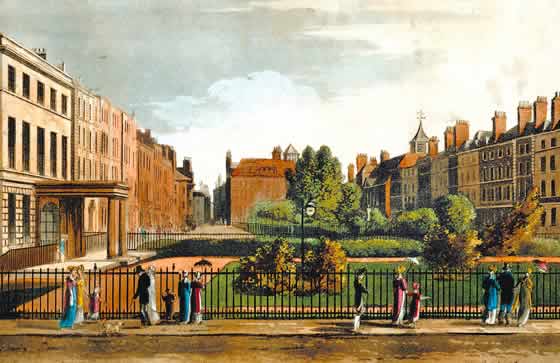
34 Gloucester Street, London
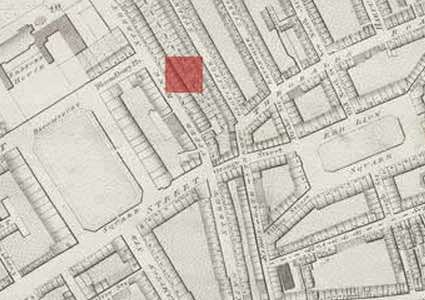
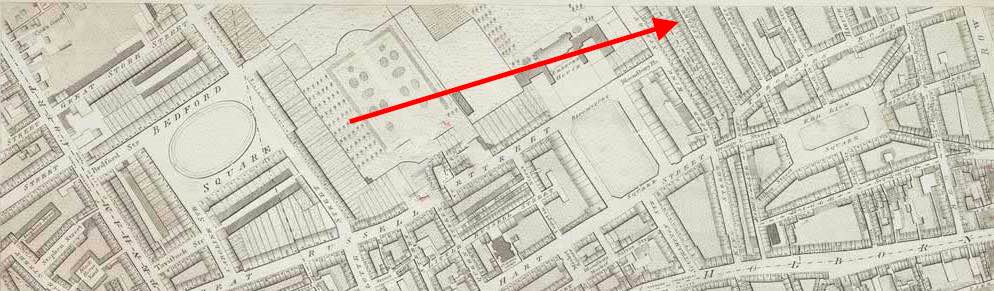
The home of the enigmatic (at least for Keats) Mrs. Isabella Jones, with whom Keats has had an earlier romantic encounter near Hastings (in an adjacent tiny village with the delightful name of Bo-Peep), May 1817.
On this day, a week before his twenty-third birthday, Keats passes Isabella on the street. He turns back to greet the stylish,
literate, and attractive woman. After some niceties and a short detour to see one
of her
friends who manages a boarding school, he presses a little so that he can walk her
home, to 34
Gloucester Street, off Queen Square, wondering all the while what it might lead to.
In a
letter to his brother and sister-in-law in America (George and Georgiana), he provides his
bottom line about her: She has always been an enigma to me
(24 Oct 1818). They spend
some time in, he notes, her salon-like sitting room, with all its books, pictures,
statues,
aeolian harp, music, and classy liquor—not to mention a couple of birds as well as
a bronze
statue of Napoleon, which perhaps suggests something about her free-thinking yet genteel
manner. In typical Keatsian fashion, he uses a sensuous metaphor to describe the room:
it is
tasty,
he writes. But nothing actively romantic happens this time around. Keats,
however, seems to have thought a little kiss might not be a bad way to part. Isabella,
without
any prudishness or offence, gently thinks otherwise. It seems a nice hand-pressing
will have
to do, and Keats claims to be okay with this.
Keats, of course, recalls that his Bo-Peep encounter almost a year and a half earlier
was
more physically amorous: he recalls he had warmed with her before and kissed her.
At
this point, though, he concludes I have no libidinous thought about her
(14-31 Oct
1818). Keats then later notes he receives much game—including pheasant—from Mrs. Jones,
which
he re-gifts, and suggests that Mrs. Jones herself has gifting friends of possibly
elevated
status, perhaps via the prominent O’Callaghan family (an Irish titled family). Keats
also
expresses that he would at some point like to nurture his friendship with her—for,
as he
writes, her mind.
Keats and Isabella agree to keep their common acquaintances
from knowing the exact history of their relationship; indeed, Isabella is well acquainted
with
others in Keats’s circle. In particular, at this same time, she has been quietly seeing
John Taylor, who is both a good friend of Keats as
well as being his co-publisher; little did they know. Perhaps her involvement with
Taylor at
the time motivated the hand-pressing rather than anything more intimate. Interestingly,
in the
letter, after writing about Isabella, Keats immediately switches to the topic of how
he is
against Matrimony
in favor of a life dedicated to Beauty and Poetry. As for Taylor,
who writes a little love poetry based on his desire for a constant amorous relationship
with
Isabella, he has to resign to the fact that it Mrs. Jones will not be his, despite
the strong
possibility that there were formal marriage intentions. [See Mark
Wiltshire, 2026])
[For more about Mrs. Jones and Keats’s first meeting with her, see May 1817.]
On the poetic side of things, Mrs. Jones is likely responsible for suggesting the Eve of St. Agnes as a poetic topic to Keats, which, in the first few months of 1819, he takes up (remarkably so!) in an engaging and remarkably atmospheric narrative poem. The poem contains a sexual encounter that, controversially, exists somewhere between an allegory of the sensual imagination and flesh-and-blood rape, coloured by deception, desire, and uncertainty. Noteworthy, too, is that Keats in his 1818 poetic retake of Boccaccio’s Decameron (fourth day, novel V) renames the heroine of the tragic tale of young lovers—Lisabetta—to his own more personal liking: Isabella; or The Pot of Basil. That Isabella is a part of the Keats circle is also apparent when, in the distribution of Keats’s library after his death, she is noted as receiving one of his books.
So who exactly Mrs Isabella Jones is—an older
women or someone the same age as Keats? a connected woman or a courtesan? the widow
of a naval
hero or a former stage singer?—has not be settled. Again, that she was somehow noteworthy
or
connected is that her portrait was painted by the ambitious and prolific portrait
artist, A.
E. Chalon (1780-1860), which ends up as item 895 (Portrait of a lady
) in the 1819
summer show of the Royal Academy. That portrait, though, seems to be missing. Once
more, we
seem to have lost Mrs. Jones.
Yet despite all mystery, Isabella remains an indelible presence within the Keats-Taylor
circle in its heyday, and this is noted in passing by someone very close to Keats—John Hamilton Reynolds. Just short of twenty years
after Keats first met Isabella, Reynolds, in a letter to Taylor of 31 October 1837, notes a few things from those good old London days; and
the very last item he lists is the beautiful Mrs. Jones!
Reynolds knows—and clearly
remembers—something of her presence.
Keats this month also expresses some barely closeted feelings about a certain Jane Cox, whom he meets via the Reynolds sisters. Within
the longer journal letter to his brother and sister-in-law in America, Keats on 14
October
bothers to describe her; she has, in fact, made Keats a little hot and bothered: Miss
Cox, he
writes, has fine eyes and fine manners,
and When she comes into a room she makes the
impression the same as the beauty of a leopardess [. . .] a man is drawn toward her
with a
magnetic power.
Keats is obviously attracted to her, and he confesses to losing some
sleep thinking about her.
In this journal letter (14-31 Oct) in which he writes about his personal circumstances,
Keats
also communicates, I hope I shall never marry.
He says, Solitude is sublime,
that there is Pleasure in Solitude,
and that he has a barrier against Matrimony
which I rejoice in.
The comments implicitly point to Keats’s desire to find, as it were,
space to study as well as to think about and compose poetry. His domestic responsibilities
and
living circumstances are anything but ideal, especially considering the care that
brother
Tom requires.
The interesting feature about the ideas he develops this October is how he plays off
the
mighty abstract Idea of Beauty,
his strengthening imagination, and concerns about his
powers for poetry
against domestic happiness.
As mentioned, his desire for and
love of poetical solitude greatly outweigh any other personal circumstance. Keats’s
commitment
to poetry is clear and his path extraordinarily confident: I think I shall be among the
English Poets after my death,
he writes 14 October to George Keats. Ten days later, he sets out his determination and
direction: The only thing that can ever affect me personally for more than one short
passing day, is any doubt about my powers for poetry—I seldom have any.
And then a few
days later, in writing to Richard Woodhouse
and attempting to muster some resolve—and after articulating his own poetical character
as
the camelion Poet
—he writes, I will assay to reach to as high a summit on Poetry
as the nerve bestowed upon me will suffer
(letter, 27 Oct). As he assesses his own
happiness in light of solitude, he confesses the yearning Passion I have for the beautiful,
connected and made one with the ambition of the intellect.
This appears to be a passing
train of thought—Enough of this,
he adds—but the idea is clearly definitive in terms of
his progress: to embrace the truthfulness of beauty in a measured, controlled manner,
and to
attempt to carefully measure his own desire and abilities; these set the way for the
qualitative leap poetry takes into 1819.
Keats’s accumulating comments about poetic directions and conditions, as well as his confidence in his poetic powers, thus point to lurking, immanent achievement. He is reaching toward, and ready for, harnessing the power of poetry. For us, though, with the hindsight of knowing his actual achievement in 1819, this is an easy prediction.
But this prediction of greatness is not just Keats’s. Woodhouse, who is realistic
and
tough-minded in his ideas about poetry and poetic greatness, this month writes to
a third
party at length about Keats’s poetic merits.
To Mary Frogley on 23 October, he
resolutely expresses his belief in Keats’s greater gifts: such original genius, I verily
believe, has not appeared since Shakespeare & Milton.
He knows Endymion displays the
faults of early work, but Reynolds puts himself out on a limb by prophesying now,
while
Keats is unknown unheeded, despised [and . . .] neglected],
and if Keats lives to a
usual age, and critics do not drive him from the free air of the poetic heaven before his
Wings are fullfledged,
that he will rank on a level with the best of the past or of
the present generation; and after his death will take his place at their head.
This is
indeed a fully-felt conviction, but Woodhouse says he makes such an enormous claim
in the
spirit of true criticism.
Well, it turns out Woodhouse was fully correct, except
inasmuch as Keats’s wings will appear within months, not years. Winter is coming,
with Spring
not far behind.