May 1817: Bo-Peep, Isabella Jones, & Endymion as a Coming-of-Age Poem
Bo-Peep (now St. Leonards-on-Sea)
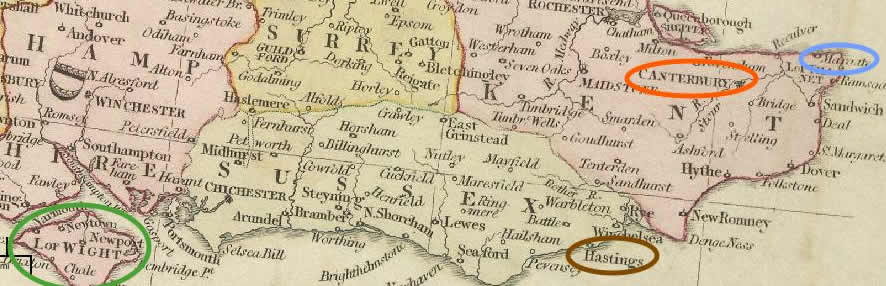
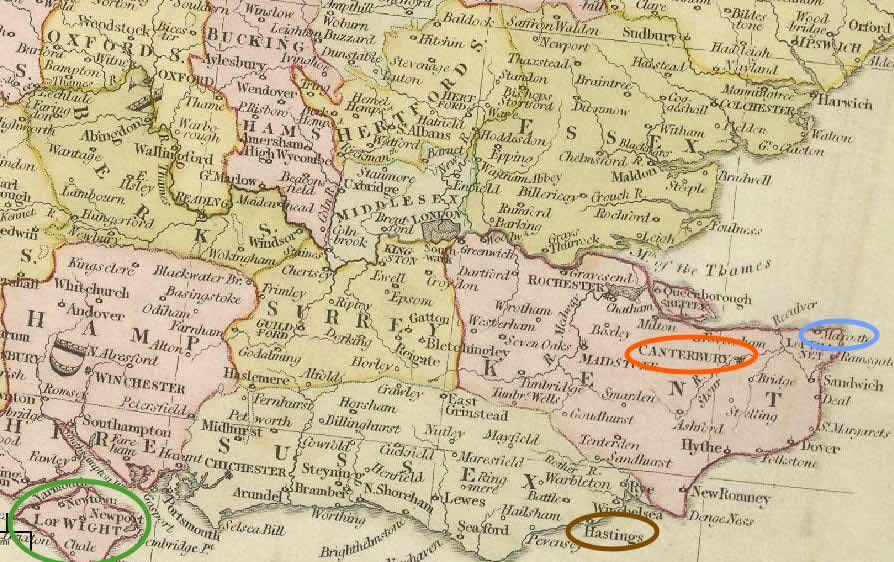
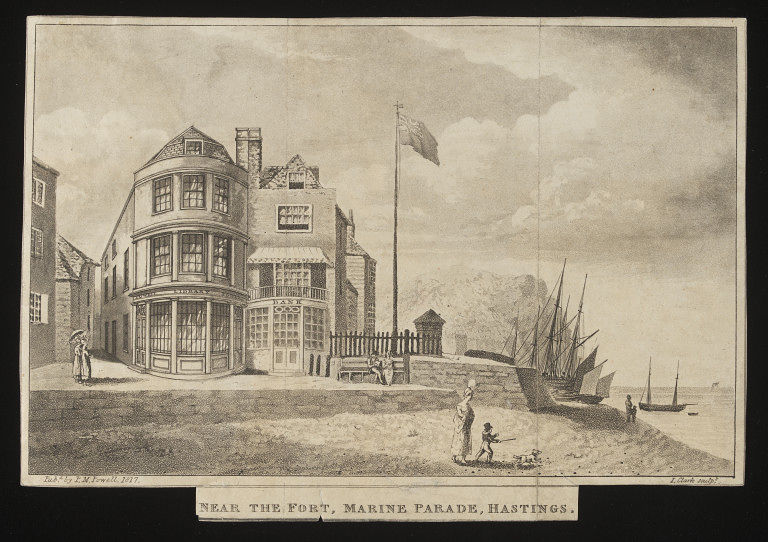
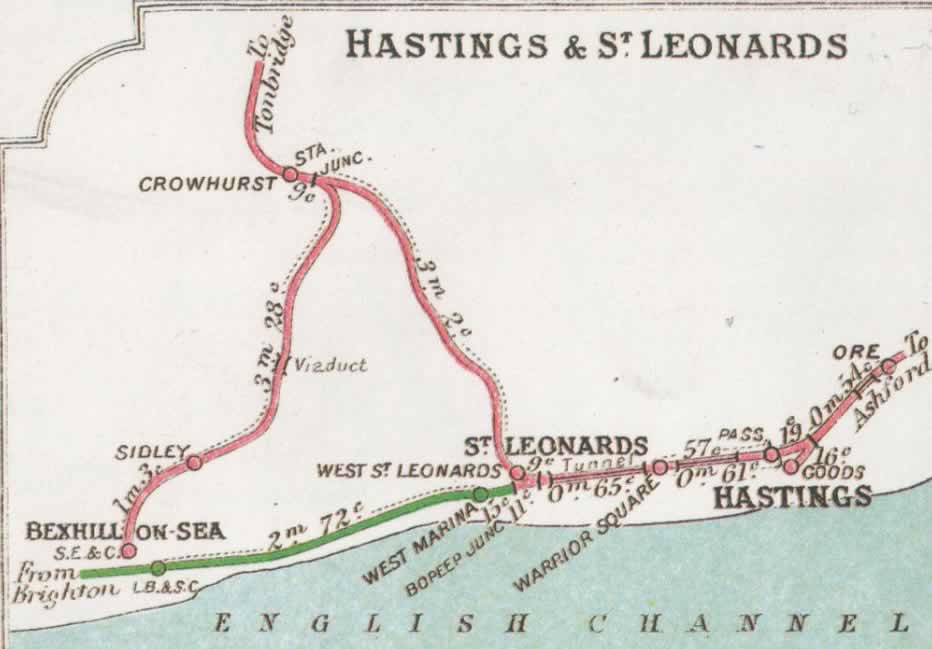
Keats’s writing trip to begin work on his long poem Endymion begins on the Isle of Wight mid-April, continues to Margate and then to Canterbury in May, and finally to the village of Bo-Peep (now St. Leonards-on-Sea), close to Hastings,* by the end of May. With the suggestion of his very close friend at this point, the painter Benjamin Robert Haydon, Keats (aged 21) stays at a small inn called The New England Bank.
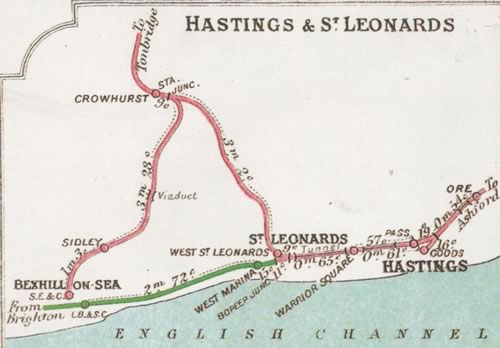
While in the area of the small village of Bo-Peep toward the end of May, Keats meets
an
alluring, smart, stylish, and, it seems, experienced woman of, it seems, independent
means,
with whom he has some kind of romantic encounter. Her name is Isabella Jones—Mrs. Jones,
aka the Hastings
Lady
—though there is no clear evidence if she is a widow or just a woman of particular
status (that is, Mrs.
was sometimes used as an honorific term to bestow a sense of
respectability, and not necessarily a term to suggest being married). We aren’t even
fully
certain of her age, which, given various scholarly pundits, ranges from being the
same age of
Keats to being a widow in her late thirties. It appears, too, she is visiting Bo-Peep
with an
older man. But whatever, Keats never quite forgets about her. He will have later meetings
with
her, including, in October 1818, a chance visit to her very cultured (or at least
artsy)
residence in the central London district of Fitzrovia, which impresses and perhaps
tantalizes
Keats with its music, aeolian harp, art, expensive booze, busts, books, and birds—as
well as
bronze statue of Napoleon, which suggests something of her free-thinking sympathies;
and
though Keats (in his own words) had warmed with her before and kissed her,
at this
later point she tastefully turns down his apparent advances in favour of pressing
him pressing
her hand upon departure, which seems not to have bothered Keats too much; in fact,
it gained
her some respect from Keats. Nevertheless, Keats no doubt hoped for at least a bit
of cuddling
and smooching (and warming), something like he experiences here, in Bo-Peep. [For
more about
this subsequent meeting with Mrs. Jones, see 24 October 1818.]
Keats will later write to his brother, George,
I have no libidinous thought about her
(22 Oct 1818), though, again, it is hard to
determine Keats’s feelings or intentions, since there seems to have been an agreement
between
Keats and Isabella to keep their connection quiet between mutual acquaintances; they
did,
after all, move in overlapping London circles. We find, too, that the enigmatic Lady
gives Keats many presents of game
that Keats re-gifts (19 Feb 1819); how she acquires
such fare suggests that, quite likely, she has some elevated social connections. Again,
who
Mrs. Jones is, and how had the means to maintain salon-like accommodation and accompanying
lifestyle, is a mystery.
Isabella Jones is perhaps the inspiration for a
couple of indifferent poems of longing written in 1817: Unheard, unfelt, unseen and Hither, hither,
love. And she seems to make a return appearance as sweet Isabel
in an 1818
poem by Keats—Hush, hush! tread
softly—where two lovers secretly meet to, at the very least, do some much-desired
kissing. Following from that, Isabella also later seems to have suggested to Keats
that he
write a poem about the one evening once a year when young virgins dream about their
future
husbands; the resulting poem is one of Keats’s first sustained masterpieces, The Eve of St.
Agnes, composed early 1819; and here, controversially, there is more than just
kissing. Finally, as mentioned, what we also know is that Mrs. Jones is or becomes
part of a
social circle that fully intersects with Keats, and in particular Keats’s publisher,
John Taylor, and includes other writers revolving
around John Scott’s
The London Magazine. In fact, it appears that Taylor and Isabella were secretly
engaged in early 1818 before being broken off [See Mark Wiltshire,
2026]); without either knowing it, then, Keats and Taylor were, at the same time,
enthralled with Isabella.
At his point, with much encouragement from Haydon, Keats works hard on long, classical romance, Endymion. However, he begins to feel a little overwhelmed by the task ahead. Keats’s
idea is simple enough: a substantial poem will be his self-testing trial of invention
and
imagination. And given that he will (unfortunately) declare in the poem’s eventual
preface
that Endymion exhibits adolescent sentiments and great
inexperience, and is hardly worthy of publication, the poem represents, in effect,
a fairly
deliberate coming-of-age project. In a way, and at best, the poem’s plot of a young
poet-like
shepherd in search of the ideal of his imagination is allegorical of Keats’s own desire
to
become a poet: a mortal poet in search of his own ideals of immortal truth and beauty.
Keats
will later say that good poetry should feel natural and surprise by fine excess
(letters, 27 Feb 1818). But the trouble with Endymion, a poem
that too often luxuriates in random description, sensation, and vision, is that there
is
excess
without it necessarily being fine
—there is, in its wandering manner,
and in spilling rhymes that over-determine sense, much obvious artifice and not that
much that
feels natural. Despite a few passages that look forward to better poetry, the poem
is much
more an act of perseverance than of achievement.
Haydon encourages Keats, in isolation, to
devote himself to reading and studying. (Shakespeare is the presiding literary presence on the trip, though this is not
overly reflected in Endymion; there are some dashes of A Midsummers Night Dream, and, like Shakespeare at moments, Keats
attempts to conjure a little medieval romance.) Haydon also urges Keats not to despair
or be
tormented by anxieties, but instead move forward without hesitation or fear
: your
energy will give you strength, & hope & comfort
(Haydon to Keats, 8 May 1817).
Keats responds by declaring that he is reading and writing about eight hours a day
(letters, 10 May). Despite this, Keats’s mood is uneven, and for moments on the dark
side: he
writes of a Morbidity of Temperament
that, as his Enemy,
strikes him at
intervals and sometimes leaves him inspirationally hampered (letters, 11 May). A few
days
later, he writes of a Brain so overwrought
and the effects of a Mental Debauch
(letters, 16 May). So what is going on with Keats? Chronic depression? Some kind of
anxiety
disorder? It might be attractive to toss some of these modern labels Keats’s way,
but given
Keats’s sensitive and hyper-articulate nature, what we have is a young man in search
of
direction but simply caught between hope and uncertainty.
At this very early stage in his poetic progress, Keats, venting to Haydon, begins to condemn Leigh Hunt’s self-declarations (delusions,
Keats calls them) of poetic
greatness (letters, 11 May). This is somewhat surprising, since Hunt, as perhaps one
center of
London’s liberal-progressive artistic and political intelligentsia, is really the
first to
discover and promote Keats, beginning in the second half of 1816. Keats begins to
think that
Hunt’s style of poetry and Hunt’s notions of his own poetic worth do not suit his
own tastes
and developing program to write enduring poetry. Yet despite Keats strongly lamenting
Hunt’s
claims to being a great poet to Haydon, Keats has just written to Hunt, praising his
journalist prowess, quoting some Shakespeare, and confessing his own anxieties and insecurities about poetry and fame,
even if for the last few days he has felt more confident.
Keats also gives Hunt a kind
of progress report on Endymion, that he is working on it every day, and that he hopes he doesn’t
miss the Goal
with his poem (10 May). Hunt will later off-handedly slight Keats’s
poem, which Keats hears about. Keats thought that perhaps Hunt was miffed that he
had not been
consulted enough in the writing of the poem.
But back to Hunt for a moment: As a writer, he was, in effect, a jack of all genres. He wrote poetry and prose in all kinds of styles and for all kinds of purposes; he is nothing short of prolific. But if we were to point to his greatest contribution (besides being an important publisher and editor), it was in the realm of the essay, within which he fairly innovatively ranges from high politics to the lower familial. The one joining factor in his writing: his voice and opinions are generally independent, and his tone is very much his own. Hunt also had a pretty good nose for literary and artistic talent, and was often a supporter of such talent ahead of contemporary critical tastes.
Keats, as a young poet, does the right thing by tackling the Endymion project, especially if viewed as an experiment or exercise in testing limits, voice, and form. We can thus expect and see that, at this point, his poetic aspirations are compromised by dashes of minor recklessness and by developing, uneven skills. Keats is, after all, a poet of unmeasured accomplishment and measureless potential—so his closest friends believe. We will also find that, for Keats, copying out the poem in early 1818 for publication (in late April 1818) is an important moment: he sees even more clearly the poem’s limitations and patchy qualities. He vows not to write in this mode again. Keats does, however, hope to call upon the Greek tradition in future writing after he accumulates some experience (so he writes in the eventual preface to Endymion); and, by the end of 1818 and in July 1819 he actually does make a return with a couple of attempts to build upon the titanic Hyperion story; and though the poetry he resultantly writes is, qualitatively, far beyond what Endymion achieves (in two poems we know as Hyperion and The Fall of Hyperion), the Hyperion project remains as two impressive fragments.